Quarterly Estimated Taxes for Freelancers: 2026-2027 Deadlines and a Simple Set-Aside System
Not tax advice. This is a plain-English summary of IRS guidance for US federal taxes, with links to the official pages. State rules differ. For your situation, use the IRS worksheets or a tax professional.
When you work for yourself, nobody withholds tax from your pay. Instead, the IRS expects you to pay during the year through estimated tax payments, usually four times a year. Miss them and you can owe a penalty even if you pay everything in April.
Do you need to pay estimated tax?
Generally, yes, if you expect to owe $1,000 or more in federal tax when you file, after subtracting withholding and refundable credits. That's common for freelancers in their first profitable year.
Estimated payments cover both income tax and self-employment tax (Social Security and Medicare for the self-employed). The IRS states the self-employment tax rate is 15.3% (12.4% Social Security plus 2.9% Medicare), applied to 92.35% of net self-employment earnings. You generally owe it once net earnings reach $400.
What is Form 1040-ES?
Form 1040-ES is the IRS package for individual estimated tax. It contains a worksheet for estimating the year's tax and the quarterly amount, the year's due dates, and payment vouchers if you pay by mail. Most people now pay electronically through the IRS's official payment options instead of mailing vouchers, but the worksheet is still the best free tool for working out how much to pay. First-time freelancers usually start with last year's return and this year's expected profit.
Deadlines
For the 2026 tax year
| Income earned | Payment due |
|---|---|
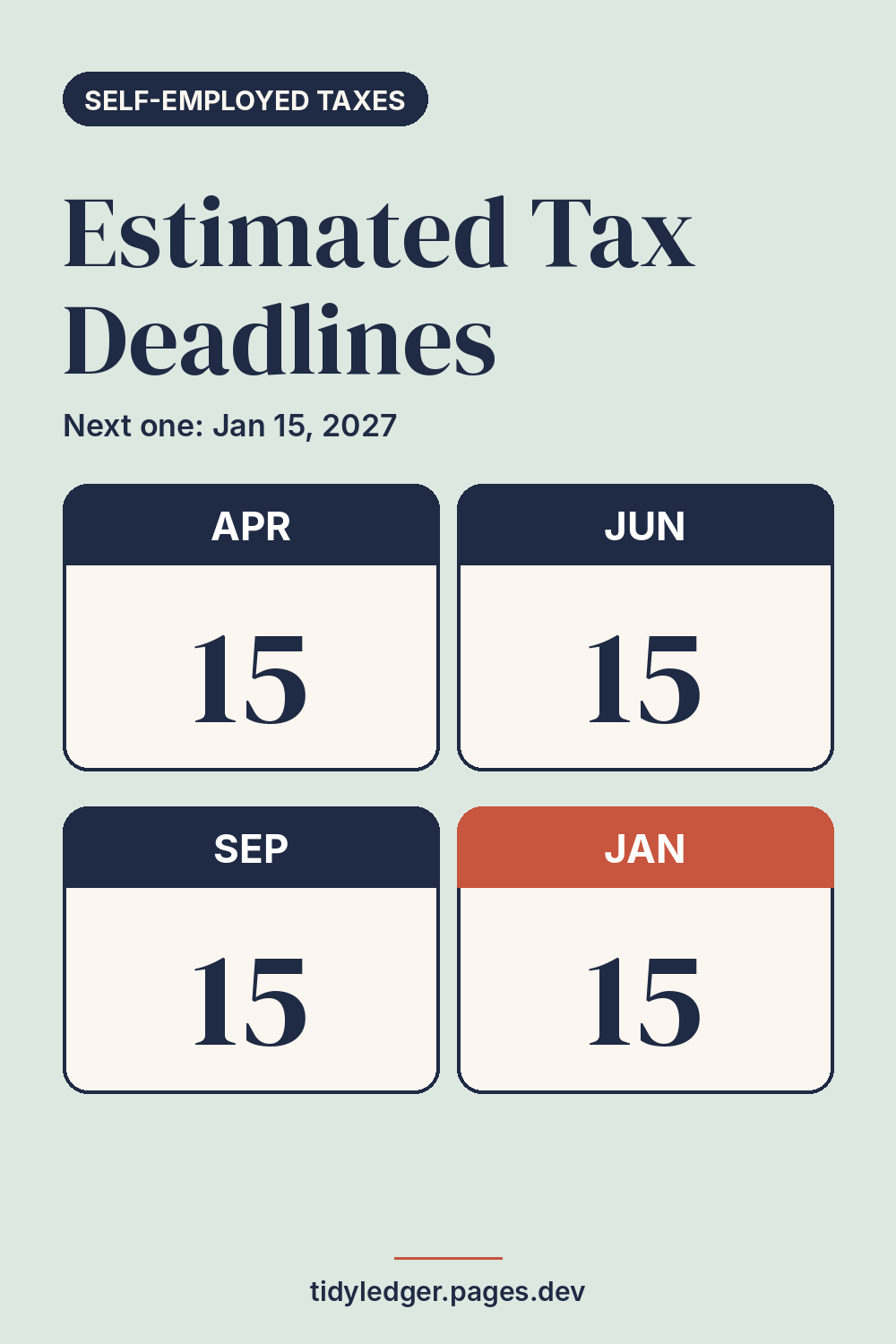
| January 1 - March 31, 2026 | April 15, 2026 |
| April 1 - May 31, 2026 | June 15, 2026 |
| June 1 - August 31, 2026 | September 15, 2026 |
| September 1 - December 31, 2026 | January 15, 2027 |
January exception: per the 2026 Form 1040-ES, you don't have to make the January 15, 2027 payment if you file your 2026 return by February 1, 2027 and pay the full balance with it.
For the 2027 tax year
The IRS rule is the 15th day of the 4th, 6th and 9th months of the tax year, plus the 15th day of the month after the year ends. For calendar-year filers that's April 15, June 15 and September 15, 2027, and January 15, 2028. January 15, 2028 falls on a Saturday; when a due date lands on a weekend or legal holiday, a payment made on the next business day is on time. Confirm the exact dates on the 2027 Form 1040-ES when the IRS releases it.
Don't forget the filing deadline: your 2026 federal return (Form 1040, with Schedule C and Schedule SE if you're self-employed) is generally due April 15, 2027, which is also the due date of the first 2027 estimated payment.
Avoiding the underpayment penalty: the "safe harbor" rules
Under IRS rules you generally won't owe an underpayment penalty if:
- you owe less than $1,000 after withholding and refundable credits, or
- you paid at least 90% of this year's tax, or
- you paid at least 100% of last year's tax (the prior-year return must cover a full 12 months). If last year's adjusted gross income was more than $150,000 ($75,000 if married filing separately), the figure is 110%.
The penalty is figured installment by installment. Paying a lot in January may not cancel a shortfall from June. If your income arrives unevenly (common for freelancers), the IRS's annualized income method can reduce or remove the penalty; see Form 2210.
How much should you set aside?
A common rule of thumb is 25-30% of profit. Here's where it comes from: self-employment tax alone works out to roughly 14.1% of profit (15.3% × 92.35%), and federal income tax and any state tax come on top. It's a starting point, not a calculation:
- It may be too high for low profits, where deductions and lower tax brackets reduce your bill.
- It may be too low for higher earners, or if you live in a high-tax state.
For a real number, use the worksheet in Form 1040-ES or ask a tax professional, then adjust your percentage.
The tax bucket system (10 minutes a week)
- Open a separate savings account and name it "Taxes". Don't touch it for anything else.
- Every time a client pays, move your set-aside percentage into it. Doing it weekly is fine too.
- Track profit as you go. Our free bookkeeping spreadsheet calculates monthly profit and applies your set-aside percentage automatically.
- Put the four deadlines in your calendar with a reminder one week before each.
- Pay electronically through the IRS's official payment options, and keep the confirmation.
- Record each payment (date and amount). You'll need the total when you file.
Can software help?
Bookkeeping software won't pay your taxes, but it keeps the profit figure up to date, which is the hard part. Intuit designed QuickBooks Solopreneur for one-person businesses filing Schedule C. Its predecessor, QuickBooks Self-Employed, estimated federal quarterly taxes but not state ones, so check the current Solopreneur feature list before relying on any estimate. If you mainly bill clients, see our FreshBooks vs QuickBooks comparison.
See QuickBooks Solopreneur (paid link)Q4 checklist: before January 15, 2027
- Bring your books up to date through December 31, 2026.
- Estimate your total 2026 tax with the 1040-ES worksheet (or ask your preparer).
- Subtract what you've already paid in 2026 estimates and withholding.
- Pay the remainder by January 15, 2027, or plan to file and pay in full by February 1, 2027.
- Save the payment confirmation with your tax records.
FAQ
What happens if I miss a quarterly payment?
The IRS may charge an underpayment penalty, calculated for the period the payment was late. Pay as soon as you can to limit it.
Do I pay estimated tax in my first year of freelancing?
If you expect to owe $1,000 or more for the year, generally yes. If you had no tax liability last year and were a US citizen or resident for the whole year, special rules may mean you don't owe a penalty; see the IRS estimated tax page.
Do states have estimated taxes too?
Many states do, with their own rules and dates. Check your state tax agency's website.
Sources (checked October 29, 2026)
- IRS, Estimated taxes: https://www.irs.gov/businesses/small-businesses-self-employed/estimated-taxes
- IRS, 2026 Form 1040-ES (due dates; January exception): https://www.irs.gov/pub/irs-pdf/f1040es.pdf
- IRS Publication 505 (2026), Tax Withholding and Estimated Tax: https://www.irs.gov/publications/p505
- IRS, Underpayment of estimated tax by individuals penalty: https://www.irs.gov/payments/underpayment-of-estimated-tax-by-individuals-penalty
- IRS Topic no. 554, Self-employment tax: https://www.irs.gov/taxtopics/tc554
- IRS Publication 334, Tax Guide for Small Business: https://www.irs.gov/publications/p334
- Intuit help, QuickBooks Self-Employed estimated taxes: https://quickbooks.intuit.com/learn-support/en-us/help-article/taxation/quickbooks-self-employed-tracks-self-employment/L6TLro1gO_US_en_US